
Dianela Osorio
Vassiliemma Spatharioti
Università di Pavia, Univeristy of Bristol, CEN
The Emotional Cerebellum
For more than a century, the cerebellum, a region at the base of the brain, was described as the “organ of movement.” It helps us maintain balance, coordinate actions, and refine motor skills. This description was not wrong, but it was incomplete. Over the past two decades, advances in neuroscience have revealed that the cerebellum also contributes to cognition, emotion, and social behaviour.
The first signs of this broader role came from clinical observation. Patients with cerebellar lesions often showed mild motor difficulties alongside marked changes in mood and behaviour, including emotional flatness, irritability, difficulties regulating feelings, and altered social behaviour. These observations led to the description of the cerebellar cognitive–affective syndrome and raised an important question: how could a structure associated with movement influence emotion?
Fear, a universal and protective emotion triggered by the perception of danger, whether physical, emotional, or psychological, has provided some of the clearest insights into how the brain learns from threat. Although fear processing was long attributed mainly to limbic and prefrontal regions, we now know that the cerebellum is also a core part of the brain’s fear network. It contributes to learning and updating fear responses, particularly when expectations about danger are violated, such as when a previously threatening situation becomes safe. By detecting when a threat is absent, the brain can tell danger from safety and gradually reduce fear expression. When this process fails, persistent fear responses are often seen in anxiety and related disorders
Importantly, cerebellar involvement is not limited to fear. Brain-imaging studies show that the cerebellum also contributes to emotional regulation, learning from emotional experiences, and social understanding. Across a range of psychiatric and neurodevelopmental conditions, anatomical and functional differences in the cerebellum, as well as altered connectivity with other brain regions, have been reported. Such alterations are observed in conditions including anxiety and mood disorders, post-traumatic stress disorder, autism spectrum conditions, and addiction, particularly affecting emotional regulation, cognition, and social behaviour.
From Movement to Emotion: A Shared Predictive Logic
It may seem surprising that a structure long associated with movement could influence emotion, but the key to this link lies not in what the cerebellum controls, but in how it works. The cerebellum is built from repeating neural circuits specialized in prediction. These circuits compare expectations with outcomes, allowing rapid correction when the two do not match. A mechanism originally described for motor control also applies to emotional and cognitive processes.
Emotions, like movements, unfold over time. They depend on expectations, feedback, and adjustment. This continuity suggests that emotion, cognition, and action are not separate domains, but expressions of shared computational principles.
A Growing Field, Still Full of Gaps
Research on the emotional cerebellum has expanded rapidly over recent decades. What was once considered a marginal topic has become an active area of investigation, spanning animal and human studies. Yet important gaps remain. Findings are often fragmented across disciplines, species, and methods, and computational approaches capable of integrating these results into unified models are still relatively scarce.
This imbalance highlights a deeper issue: progress in studying complex processes such as emotion depends not only on gathering data, but on connecting different levels of explanation. Without integration, even robust findings risk remaining incomplete pieces of a larger puzzle.
Seeing the whole picture, therefore, is not only a scientific challenge, but also a methodological one.
Science Works Better When It Is Shared
Recognising the cerebellum’s role in emotion invites a broader rethinking of brain organisation. Rather than functioning as isolated modules, brain regions appear to collaborate within shared functional frameworks. The emotional cerebellum exemplifies a wider transition in neuroscience, from static anatomy to dynamic function, and from isolated data to integrated knowledge.
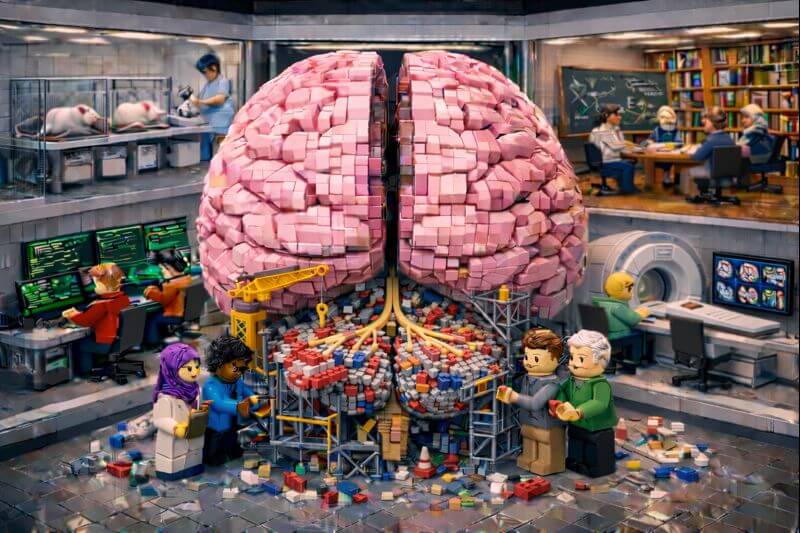
The study of the cerebellum, like much of modern neuroscience, is a collective endeavour. Each laboratory contributes fragments of a vast mosaic: brain images, electrical recordings, genomic data, and computational models. On their own, these fragments offer partial views. Without coordination, they remain parts of a picture we cannot fully see.
Interdisciplinarity lies at the heart of modern science. Many breakthroughs occur at disciplinary boundaries, where different perspectives intersect and challenge one another. Yet interdisciplinarity also brings challenges. When conceptual languages fail to align, collaboration can stall. Models may become mathematically elegant but biologically implausible, or theories may drift away from clinical reality. Another recurring risk is reductionism, the belief that equations can replace biology, or that complex behaviour can be fully captured by models alone. Interdisciplinarity works only when it builds genuine bridges, not invasions. It requires humility, mutual learning, and time: learning to think together without thinking the same.
In our research network, CEN (Cerebellum and Emotional Networks), a MSCA ITN programme, we create a bridge between fundamental and clinical research, bringing together researchers, industry, and charities across Europe to address, from a holistic research approach, the contribution of the cerebellum to emotional control, particularly fear and anxiety.
This is the direction toward which contemporary neuroscience is moving, not merely toward more data or better models, but toward a more connected, reflective, and humane science. Only such a science will be able to understand, in all its complexity, the brain that creates it.
Computational neuroscience is becoming central to this shift. By linking experimental data with models and simulations, it offers tools to bridge gaps between levels of analysis that biology alone cannot span. Open-data repositories have become essential, but technical openness is not enough: cultural openness matters just as much. This shift requires rethinking how we value collaboration, credit, and collective progress. Despite unprecedented opportunities for collaboration, real progress still hinges on human factors: communication, trust, and a willingness to work across boundaries. Overcoming these challenges will require continued efforts not only toward data sharing, standardization, and ethical considerations, but also toward building scientific communities capable of genuine integration. In the end, the most intelligent science will be the one capable of communicating with itself.
(ΕΛΛ)
Η Παρεγκεφαλίδα σε Επανεξέταση: Γιατί η Kατανόηση του Eγκεφάλου απαιτεί να δούμε τη Συνολική Εικόνα
Dianela Osorio
Vassiliemma Spatharioti
Università di Pavia, Univeristy of Bristol, CEN
Ο Ρόλος της Παρεγκεφαλίδας στα Συναισθήματα
Για περισσότερο από έναν αιώνα, η παρεγκεφαλίδα, μια περιοχή στη βάση του εγκεφάλου, περιγραφόταν ως το «όργανο της κίνησης». Η παρεγκεφαλίδα, μας βοηθά να διατηρούμε την ισορροπία μας, να συντονίζουμε τις πράξεις μας και να τελειοποιούμε κινητικές δεξιότητες. Αυτή η περιγραφή δεν είναι λανθασμένη, αλλά είναι ελλιπής. Τα τελευταία είκοσι χρόνια, οι εξελίξεις στη νευροεπιστήμη έχουν αποκαλύψει ότι η παρεγκεφαλίδα συμβάλλει επίσης στις γνωστικές διεργασίες, στο συναίσθημα και στην κοινωνική συμπεριφορά.
Τα πρώτα σημάδια αυτού του ευρύτερου ρόλου προήλθαν από κλινικές παρατηρήσεις. Ασθενείς με βλάβες της παρεγκεφαλίδας συχνά παρουσίαζαν ήπιες κινητικές δυσκολίες μαζί με έντονες αλλαγές στη διάθεση και στη συμπεριφορά, συμπεριλαμβανομένης της συναισθηματικής επιπέδωσης, της ευερεθιστότητας, δυσκολιών στη ρύθμιση των συναισθημάτων και αλλοιωμένης κοινωνικής συμπεριφοράς. Οι παρατηρήσεις αυτές οδήγησαν στην περιγραφή του παρεγκεφαλιδικού γνωστικο-συναισθηματικού συνδρόμου και έθεσαν ένα σημαντικό ερώτημα: πώς θα μπορούσε μια δομή που σχετίζεται με την κίνηση να επηρεάζει το συναίσθημα;
Ο φόβος, ένα καθολικό και προστατευτικό συναίσθημα που ενεργοποιείται όταν αντιλαμβανόμαστε σωματικό, συναισθηματικό ή ψυχολογικό κίνδυνο, έχει προσφέρει από τις πιο σαφείς ενδείξεις για τον τρόπο με τον οποίο ο εγκέφαλος μαθαίνει και προσαρμόζεται απέναντι στην απειλή. Παρότι η επεξεργασία του φόβου για μεγάλο διάστημα συνδεόταν κυρίως με μεταιχμιακές και προμετωπιαίες περιοχές, σήμερα γνωρίζουμε ότι η παρεγκεφαλίδα αποτελεί επίσης βασικό μέρος του νευρωνικού δικτύου του φόβου. Η παρεγκεφαλίδα διαδραματίζει σημαντικό ρόλο στη μάθηση και στην αναπροσαρμογή των αντιδράσεων απέναντι στον φόβο και ιδιαίτερα όταν παραβιάζονται οι προσδοκίες ως προς τον κίνδυνο, όπως στην περίπτωση κατά την οποία μια μέχρι πρότινος απειλητική κατάσταση επαναξιολογείται ως ασφαλής. Ανιχνεύοντας την απουσία της απειλής, ο εγκέφαλος μπορεί να διακρίνει τον κίνδυνο από την ασφάλεια και σταδιακά να μειώνει την έκφραση του φόβου. Όταν αυτή η διαδικασία αποτυγχάνει, επίμονες αντιδράσεις φόβου παρατηρούνται συχνά σε αγχώδεις και συναφείς διαταραχές.
Ωστόσο, η συμβολή της παρεγκεφαλίδας στην επεξεργασία των συναισθημάτων δεν περιορίζεται αποκλειστικά στον φόβο. Μελέτες νευροαπεικόνισης δείχνουν ότι η παρεγκεφαλίδα συμβάλλει επίσης στη συναισθηματική ρύθμιση, στη μάθηση από συναισθηματικές εμπειρίες και στην κοινωνική κατανόηση. Σε ένα ευρύ φάσμα ψυχιατρικών και νευροαναπτυξιακών καταστάσεων έχουν αναφερθεί ανατομικές και λειτουργικές διαφοροποιήσεις της παρεγκεφαλίδας, καθώς και μεταβολές στη συνδεσιμότητά της με άλλες εγκεφαλικές περιοχές. Τέτοιες αλλοιώσεις έχουν παρατηρηθεί σε κλινικές καταστάσεις όπως οι αγχώδεις διαταραχές, οι διαταραχές της διάθεσης, η διαταραχή μετατραυματικού στρες, το φάσμα του αυτισμού και ο εθισμός, επηρεάζοντας ιδίως τη συναισθηματική ρύθμιση, τις γνωστικές λειτουργίες και την κοινωνική συμπεριφορά.
Από την Κίνηση στο Συναίσθημα: Μια κοινή Προβλεπτική Λογική
Μπορεί να φαίνεται παράδοξο ότι μια δομή που συνδέθηκε επί μακρόν με την κίνηση θα μπορούσε να επηρεάζει το συναίσθημα, όμως το κλειδί αυτής της σύνδεσης δεν βρίσκεται στο τι ελέγχει η παρεγκεφαλίδα, αλλά στον τρόπο με τον οποίο λειτουργεί. Η παρεγκεφαλίδα αποτελείται από επαναλαμβανόμενα νευρωνικά κυκλώματα εξειδικευμένα στην πρόβλεψη. Αυτά τα κυκλώματα συγκρίνουν τις προσδοκίες με τα αποτελέσματα, επιτρέποντας τη γρήγορη διόρθωση όταν τα δύο δεν ταυτίζονται. Ένας μηχανισμός που αρχικά περιγράφηκε για τον κινητικό έλεγχο φαίνεται ότι εφαρμόζεται και σε συναισθηματικές και γνωστικές διεργασίες.
Τα συναισθήματα, όπως και οι κινήσεις, εξελίσσονται στον χρόνο και εξαρτώνται από τις προσδοκίες, την ανατροφοδότηση και την προσαρμογή. Η συνέχεια αυτή υποδηλώνει ότι το συναίσθημα, η γνωστική λειτουργία και η δράση δεν αποτελούν διακριτούς τομείς, αλλά εκφράσεις κοινών υπολογιστικών αρχών.
Ένα Αναπτυσσόμενο Πεδίο, ακόμη Γεμάτο Κενά
Η έρευνα για την παρεγκεφαλίδα στο πεδίο των συναισθημάτων έχει αναπτυχθεί ραγδαία τις τελευταίες δεκαετίες. Ό,τι κάποτε θεωρούνταν περιθωριακό θέμα έχει εξελιχθεί σε ενεργό πεδίο διερεύνησης, που περιλαμβάνει μελέτες σε ζώα και ανθρώπους. Ωστόσο, σημαντικά κενά παραμένουν. Τα ευρήματα συχνά είναι κατακερματισμένα ανάμεσα σε διαφορετικές επιστημονικές περιοχές, είδη και μεθόδους, ενώ οι υπολογιστικές προσεγγίσεις που θα μπορούσαν να ενοποιήσουν αυτά τα αποτελέσματα σε ενιαία μοντέλα παραμένουν σχετικά περιορισμένες.
Αυτή η ανισορροπία αναδεικνύει ένα βαθύτερο ζήτημα: η πρόοδος στη μελέτη πολύπλοκων διεργασιών, όπως το συναίσθημα, εξαρτάται όχι μόνο από τη συλλογή δεδομένων, αλλά και από τη σύνδεση διαφορετικών επιπέδων ερμηνείας. Χωρίς ενοποίηση, ακόμη και ισχυρά ευρήματα κινδυνεύουν να παραμείνουν αποσπασματικά κομμάτια ενός ευρύτερου παζλ.
Η θέαση της συνολικής εικόνας, επομένως, δεν αποτελεί μόνο επιστημονική πρόκληση, αλλά και μεθοδολογική.
Η Επιστήμη Λειτουργεί Καλύτερα οταν Μοιράζεται
Η αναγνώριση του ρόλου της παρεγκεφαλίδας στο συναίσθημα μας καλεί να επανεξετάσουμε ευρύτερα την οργάνωση του εγκεφάλου. Αντί να λειτουργούν ως απομονωμένες μονάδες, οι εγκεφαλικές περιοχές φαίνεται να συνεργάζονται μέσα σε κοινά λειτουργικά πλαίσια. Η παρεγκεφαλίδα αποτελεί χαρακτηριστικό παράδειγμα μιας ευρύτερης μετάβασης στη νευροεπιστήμη: από τη στατική ανατομία στη δυναμική λειτουργία και από τα απομονωμένα δεδομένα στην ενοποιημένη γνώση.
Η μελέτη της παρεγκεφαλίδας, όπως και μεγάλο μέρος της σύγχρονης νευροεπιστήμης, αποτελεί συλλογική προσπάθεια. Κάθε εργαστήριο συμβάλλει με θραύσματα ενός τεράστιου μωσαϊκού: εγκεφαλικές εικόνες, ηλεκτρικές καταγραφές, γονιδιωματικά δεδομένα και υπολογιστικά μοντέλα. Από μόνα τους, αυτά τα θραύσματα προσφέρουν μερικές μόνο όψεις. Χωρίς συντονισμό, παραμένουν τμήματα μιας εικόνας που δεν μπορούμε να δούμε πλήρως.
Η διεπιστημονικότητα βρίσκεται στον πυρήνα της σύγχρονης επιστήμης. Πολλές ανακαλύψεις προκύπτουν στα όρια των επιστημονικών πεδίων, εκεί όπου διαφορετικές οπτικές συναντώνται και δοκιμάζουν η μία την άλλη. Ωστόσο, η διεπιστημονικότητα φέρνει και προκλήσεις. Όταν οι εννοιολογικές γλώσσες δεν ευθυγραμμίζονται, η συνεργασία μπορεί να παρεμποδιστεί. Τα μοντέλα μπορεί να γίνουν μαθηματικά κομψά αλλά βιολογικά μη ρεαλιστικά, ή οι θεωρίες να απομακρυνθούν από την κλινική πραγματικότητα. Ένας ακόμη επαναλαμβανόμενος κίνδυνος είναι ο αναγωγισμός, η πεποίθηση ότι οι εξισώσεις μπορούν να αντικαταστήσουν τη βιολογία ή ότι η σύνθετη συμπεριφορά μπορεί να αποτυπωθεί πλήρως μόνο μέσω μοντέλων. Η διεπιστημονικότητα λειτουργεί μόνο όταν οικοδομεί γνήσιες γέφυρες και όχι «εισβολές». Απαιτεί ταπεινότητα, αμοιβαία μάθηση και χρόνο: να μάθουμε να σκεφτόμαστε μαζί χωρίς να σκεφτόμαστε το ίδιο.
Στο ερευνητικό μας δίκτυο, CEN (Cerebellum and Emotional Networks), ένα πρόγραμμα MSCA ITN, δημιουργούμε μια γέφυρα μεταξύ βασικής και κλινικής έρευνας, φέρνοντας κοντά ερευνητές, βιομηχανίες και φιλανθρωπικούς οργανισμούς απο όλη την Ευρώπη, προκειμένου να διερευνήσουμε, μέσα από μια ολιστική ερευνητική προσέγγιση, τη συμβολή της παρεγκεφαλίδας στον συναισθηματικό έλεγχο και ιδιαίτερα στον φόβο και στο άγχος.
Αυτή είναι η κατεύθυνση προς την οποία κινείται η σύγχρονη νευροεπιστήμη, όχι απλώς προς περισσότερα δεδομένα ή καλύτερα μοντέλα, αλλά προς μια πιο συνδεδεμένη, στοχαστική και ανθρώπινη επιστήμη. Μόνο μια τέτοια επιστήμη θα μπορέσει να κατανοήσει, σε όλη της την πολυπλοκότητα, τον εγκέφαλο που τη δημιουργεί.
Η υπολογιστική νευροεπιστήμη καθίσταται κεντρική σε αυτή τη μετατόπιση. Συνδέοντας τα πειραματικά δεδομένα με μοντέλα και προσομοιώσεις, προσφέρει εργαλεία για να γεφυρώσει χάσματα μεταξύ επιπέδων ανάλυσης που η βιολογία από μόνη της δεν μπορεί να καλύψει. Τα αποθετήρια ανοιχτών δεδομένων έχουν καταστεί απαραίτητα, αλλά η τεχνική διαφάνεια από μόνη της δεν αρκεί: η πολιτισμική διαφάνεια έχει εξίσου μεγάλη σημασία. Αυτή η αλλαγή απαιτεί επαναπροσδιορισμό του τρόπου με τον οποίο αποτιμούμε τη συνεργασία, την αναγνώριση και τη συλλογική πρόοδο.
Παρά τις πρωτοφανείς ευκαιρίες για συνεργασία, η πραγματική πρόοδος εξακολουθεί να εξαρτάται από ανθρώπινους παράγοντες: την επικοινωνία, την εμπιστοσύνη και την προθυμία να εργαστούμε πέρα από τα όρια των επιμέρους πεδίων. Η υπέρβαση αυτών των προκλήσεων απαιτεί συνεχιζόμενες προσπάθειες όχι μόνο προς την κατεύθυνση της κοινοποίησης δεδομένων, της τυποποίησης και των ηθικών προβληματισμών, αλλά και προς την οικοδόμηση επιστημονικών κοινοτήτων ικανών για ουσιαστική ενοποίηση. Τελικά, η πιο ευφυής επιστήμη θα είναι εκείνη που θα μπορεί να επικοινωνεί με τον εαυτό της.
(ESP)
Reconsiderando el cerebelo: por qué entender el cerebro exige ver el panorama completo
Dianela Osorio
Vassiliemma Spatharioti
Università di Pavia, Univeristy of Bristol, CEN
El cerebelo emocional
Durante más de un siglo, el cerebelo, una región situada en la base del cerebro, fue descrito como el “órgano del movimiento”. Nos ayuda a mantener el equilibrio, coordinar acciones y perfeccionar habilidades motoras. Esta descripción no era incorrecta, pero sí incompleta. En las últimas dos décadas, los avances en neurociencia han demostrado que el cerebelo también participa en la cognición, la emoción y el comportamiento social.
Las primeras señales de este papel más amplio surgieron de la observación clínica. Los pacientes con lesiones en el cerebelo mostraban alteraciones motoras leves, pero presentaban cambios emocionales y conductuales significativos. Entre estos se observaban disminución de la expresión afectiva, irritabilidad, dificultades para regular las emociones y problemas en la interacción social. Estas observaciones dieron lugar a la descripción del síndrome cognitivo-afectivo cerebeloso y plantearon una pregunta clave: ¿cómo puede una estructura tradicionalmente asociada al movimiento influir en la emoción?
El miedo, una emoción universal y protectora que se activa ante la percepción de peligro, ya sea físico, emocional o psicológico, ha proporcionado algunas de las claves más claras para comprender cómo el cerebro aprende a partir de la amenaza. Aunque durante mucho tiempo el procesamiento del miedo se atribuyó principalmente a regiones límbicas y prefrontales, hoy sabemos que el cerebelo también forma parte esencial de la red cerebral del miedo. Participa en el aprendizaje y la actualización de las respuestas de temor, especialmente cuando se incumplen las expectativas sobre el peligro, por ejemplo, cuando una situación previamente amenazante deja de serlo. Al detectar la ausencia de amenaza, el cerebro puede distinguir entre peligro y seguridad y reducir gradualmente la expresión del miedo. Cuando este proceso falla, aparecen respuestas de miedo persistentes, características de diversos trastornos de ansiedad y otros cuadros relacionados.
Es importante destacar que la implicación del cerebelo no se limita al miedo. Estudios de neuroimagen muestran que también contribuye a la regulación emocional, al aprendizaje a partir de experiencias afectivas y a la comprensión social. En diversas condiciones psiquiátricas y del neurodesarrollo se han descrito diferencias anatómicas y funcionales en el cerebelo, así como alteraciones en su conectividad con otras regiones cerebrales. Entre los cuadros en los que se han documentado estas alteraciones se incluyen los trastornos de ansiedad y del estado de ánimo, el trastorno por estrés postraumático, los trastornos del espectro autista, las adicciones, la esquizofrenia, el trastorno por déficit de atención e hiperactividad, el trastorno obsesivo-compulsivo, entre otros. En estos casos, las alteraciones afectan especialmente a la regulación emocional, la cognición y la conducta social.
Del movimiento a la emoción: una lógica predictiva compartida
Puede resultar sorprendente que una estructura asociada durante tanto tiempo al movimiento influya en la emoción. Sin embargo, la clave de este vínculo no está en lo que el cerebelo controla, sino en cómo funciona. El cerebelo está compuesto por circuitos neuronales repetitivos especializados en la predicción. Estos circuitos comparan expectativas con resultados y permiten correcciones rápidas cuando ambos no coinciden. Un mecanismo descrito originalmente para el control motor puede extenderse también a los procesos emocionales, cognitivos y sociales.
Las emociones, al igual que los movimientos, se desarrollan en el tiempo. Dependen de expectativas, retroalimentación y ajustes continuos. Esta continuidad sugiere que emoción, cognición y acción no son dominios independientes, sino manifestaciones de principios computacionales compartidos.
Un campo en expansión, con lagunas aún por esclarecer
La investigación sobre el cerebelo emocional ha crecido de manera acelerada en las últimas décadas. Lo que antes era un tema poco explorado se ha convertido en un área activa de estudio, tanto en modelos animales como en humanos. Sin embargo, persisten lagunas importantes. La evidencia disponible se encuentra frecuentemente fragmentada entre disciplinas, especies y aproximaciones metodológicas, mientras que los enfoques computacionales orientados a su integración en modelos unificados continúan siendo escasos.
Este desequilibrio pone de relieve un problema más profundo: el progreso en el estudio de procesos complejos como la emoción no depende únicamente de acumular datos, sino de conectar distintos niveles de explicación. Sin integración, incluso los hallazgos más sólidos corren el riesgo de quedar como piezas aisladas de un rompecabezas mayor.
Ver el panorama completo no es solo un desafío científico, sino también metodológico y conceptual.
La ciencia funciona mejor cuando se comparte
Reconocer el papel del cerebelo en la emoción invita a repensar de forma más amplia la organización del cerebro. Más que funcionar como módulos aislados, las regiones cerebrales parecen colaborar dentro de marcos funcionales compartidos. El cerebelo emocional ejemplifica una transición más amplia en la neurociencia: del énfasis en la anatomía estática a la función dinámica, y de los datos aislados a una comprensión integrada del cerebro como sistema.
El estudio del cerebelo, como gran parte de la neurociencia contemporánea, es un esfuerzo colectivo. Cada laboratorio aporta fragmentos a un mosaico inmenso: imágenes cerebrales, registros eléctricos, datos genómicos y modelos computacionales. Por sí solos, estos fragmentos ofrecen visiones parciales. Sin coordinación, siguen siendo partes de una imagen que no alcanzamos a ver por completo.
La interdisciplinariedad está en el corazón de la ciencia moderna. Muchos avances surgen en los límites entre disciplinas, donde perspectivas distintas se cruzan y se cuestionan mutuamente. Sin embargo, también implica desafíos. Cuando los lenguajes conceptuales no logran alinearse, la colaboración puede estancarse. Los modelos pueden volverse matemáticamente elegantes, pero biológicamente poco realistas, o las teorías pueden alejarse de la realidad clínica. Otro riesgo recurrente es el reduccionismo: la idea de que las ecuaciones pueden sustituir a la biología o que la conducta compleja puede capturarse plenamente mediante modelos. La interdisciplinariedad solo funciona cuando construye puentes genuinos, y no cuando un enfoque se impone sobre otro. Requiere humildad, aprendizaje mutuo y tiempo: aprender a pensar juntos sin pensar igual.
En nuestra red de investigación, CEN (Cerebellum and Emotional Networks), un programa MSCA ITN, tendemos un puente entre la investigación básica y la clínica, reuniendo investigadores, industria y organizaciones benéficas de toda Europa para abordar, desde una perspectiva integral, la contribución del cerebelo al control emocional, especialmente en el miedo y la ansiedad.
En esa dirección avanza actualmente la neurociencia: no solo hacia más datos o mejores modelos, sino hacia una ciencia más conectada, reflexiva y humana. Solo así será posible comprender, en toda su complejidad, el cerebro que la origina.
La neurociencia computacional ocupa un lugar central en esta transformación. Al vincular datos experimentales con modelos y simulaciones, ofrece herramientas para salvar brechas entre niveles de análisis que la biología por sí sola no puede abarcar. Los repositorios de datos abiertos se han vuelto esenciales, pero la apertura técnica no basta: la apertura cultural es igualmente importante. Este cambio exige replantear cómo valoramos la colaboración, el reconocimiento y el progreso colectivo.
A pesar de las oportunidades sin precedentes para colaborar, el verdadero avance sigue dependiendo de factores humanos: la comunicación, la confianza y la disposición a trabajar más allá de las fronteras disciplinarias. Superar estos desafíos requerirá esfuerzos sostenidos no solo en el intercambio de datos, la estandarización y las consideraciones éticas, sino también en la construcción de comunidades científicas capaces de una integración genuina.
Al final, la ciencia más inteligente será aquella capaz de dialogar consigo misma.
Leave a Reply